Which are more valuable, steals or blocks? This is a classic question asked by many basketball fans, and so far no consensus has been reached. On one hand, a steal is guaranteed to earn the team possession of the ball, and it may lead to a fast break opportunity. On the other hand, blocks stop shots that tend to be closer to the basket and have a high chance of going in.
There are several approaches that can be taken to compare the relative value of a steal and a block. The main focuses of this series will be the will be the correlation between steals/blocks and a team’s regular season or playoff success, and the impact that steals and blocks have on an individual player’s advanced stats.
1. Preliminaries
In addition to using steals per game and blocks per game, we will use adjusted steals and adjusted blocks to account for changes over time in the prevalence of steals and blocks. The formula is just:
(adjusted stat per game) = (stat per game) – (average stat per game over all teams for the season)
Also, when we compare the values of stats, we will often compare correlation coefficients. A point to emphasize is that just because R2 values are tiny doesn’t mean they can’t be compared. Saying that blocks vs win% has R2 of 0.05 means that 5% of the variation in a team’s win% can be accounted for solely by blocks. It is expected that these numbers would be low, as there are obviously more significant factors to a team’s success. In other words, if all you knew was that one team averaged more blocks that another, you wouldn’t have much confidence on which team is better.
Also, data for steals and blocks only began being recorded in the 1972-73 season, so we don’t have access to those stats prior to that.
2. How Blocks and Steals affect Regular Season Success
For this series, regular season success will be defined as win percentage. That is ultimately what determines a team’s seeding, which is the goal of the regular season.
2.1 Regular Season Win Percentage vs (adjusted) Blocks

The scatter plot above includes all teams since 1972-73, comparing their raw blocks per game to their win percentage. There is a positive, but not so significant correlation. The one thing that stands out is that all teams that averaged less than 3 blocks per game had losing seasons. Besides that, for pretty much any level of blocks there were plenty of successful and unsuccessful teams.
We also consider adjusted blocks per game:

There is almost no difference in slope or correlation when converting to adjusted blocks. Once again, the worst teams tended to not fare well, and the best teams seemed to have mixed results.
2.2 Regular Season Win Percentage vs (adjusted) Steals

Here, there is a very weak but positive correlation. At pretty much all levels of steals there are both successful and unsuccessful teams, although the very two top teams in steals had good seasons. When looking at adjusted steals, there is a significant difference:

When using adjusted steals per game, the correlation improves significantly amount, going from 0.015 to 0.023. Still, both of these are much lower than the correlations for blocks, strongly suggesting that blocks matter more to a team’s regular season success. This is further supported by blocks having a higher slope, meaning that in general, an additional block above average has a bigger effect than an additional steal above average.
2.3 How have the Relationships Changed Over Time?
We have the overall picture of how the correlations look for all seasons combined, and we can also look at how they change from season to season. First, we look at the slopes (win percentage vs adjusted blocks/steals) over time:
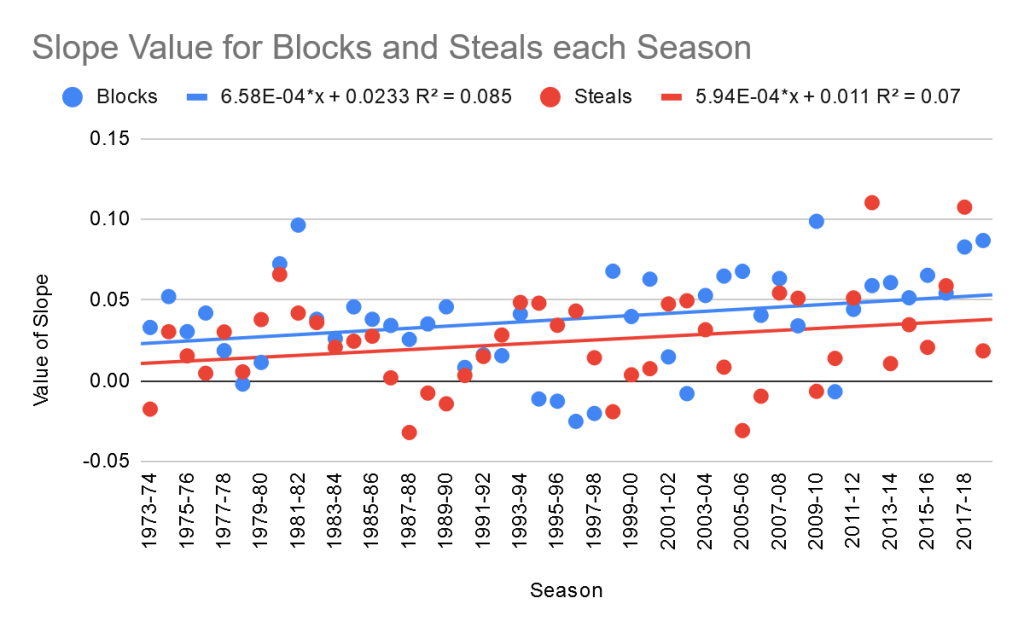
In both cases, the trend-lines are positively sloped, meaning that the value of an individual steal/block above the league average has continued increasing. Still, there is a lot of variation each season, and sometimes the slope for a given season is negative. The other thing to note is that the trend-line for blocks is above that for steals, supporting the conclusion that blocks have on average been more valuable. In addition to slopes, which show average value, we can also look at R2 over time, which show correlation over time:
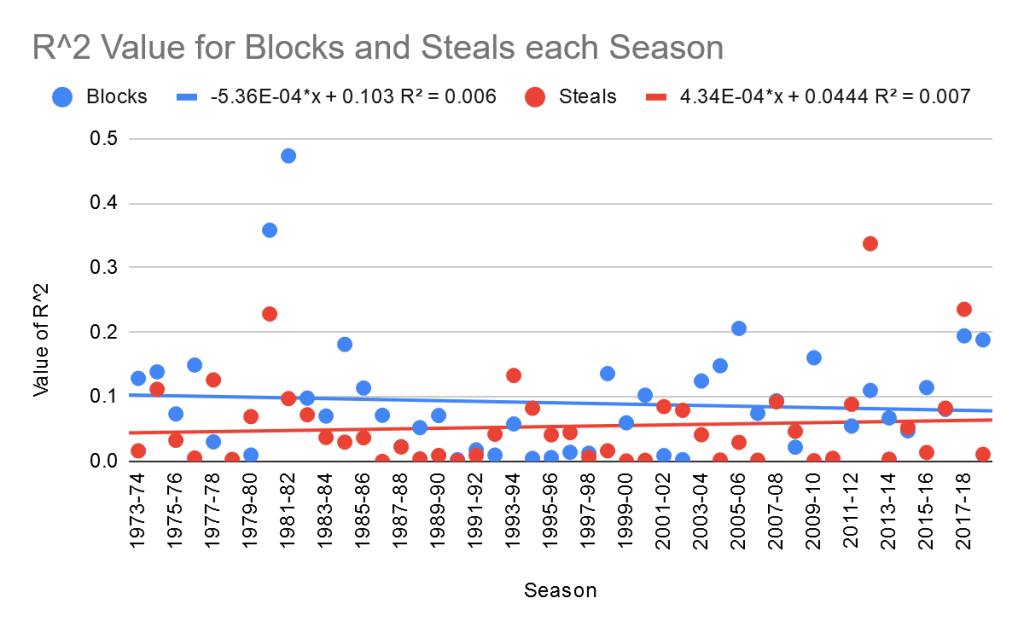
In this case the steals seem to have improving correlations over time while blocks have decreasing correlations over time. However, the two outliers in 1981 and 1982 could be what causes the trend-line for blocks to slope downwards. Either way, at least up to now the trend-line for blocks is higher, meaning that overall there has been a stronger relationship with blocks and win percentage as opposed to steals and win percentage.
What’s Next?
In part 1, we’ve concluded that blocks are more valuable than steals when it comes to regular season team success. In part 2, we’ll compare the values of steals and blocks when it comes to team success in the playoffs.

 All-Star Analytics