Make sure to check out part 1 and part 2 first.
We’ve seen teams are better off having a top player with more total win shares, and that having players with more total win shares tend to account for a higher percentage of their teams total wins. The final question is whether or not having a top player who accounts for a higher percentage of a team’s win shares is correlated with success. We will look at the relationship in both the regular season and playoffs.
2.2 Best Player’s Win Share Percentage vs Regular Season Success
In the graph, carry percentage represents the percentage of a team’s wins that are accounted for by the top player’s win shares.
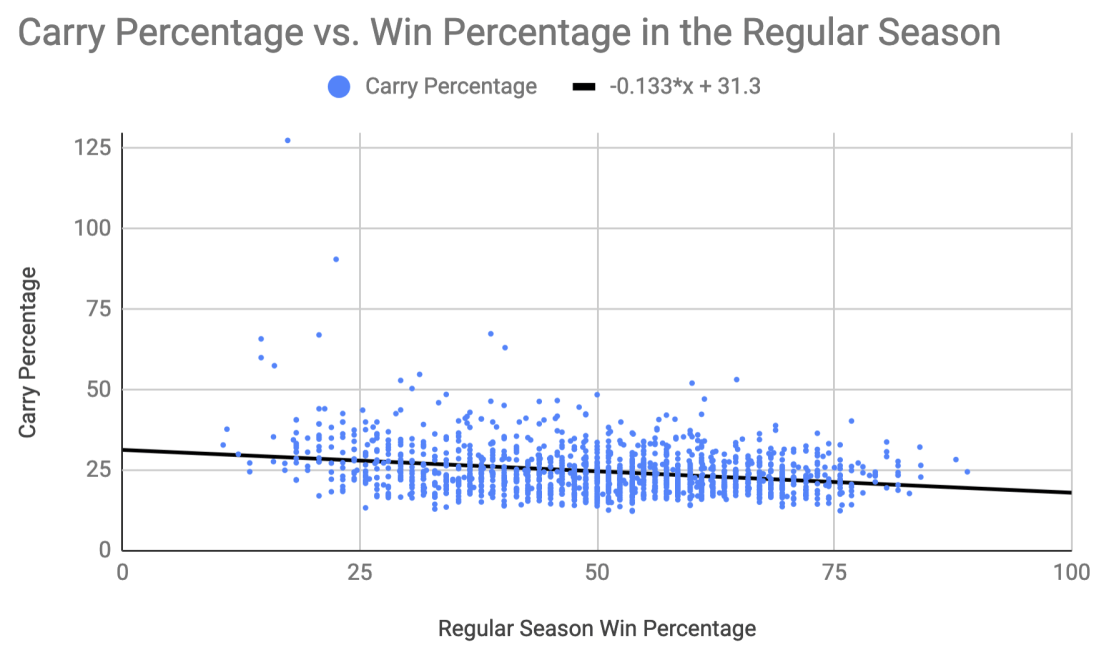
While the correlation is negative, it isn’t very strong. One thing that stands out is that the extreme end players with carry percentages of above 60% never had a winning, which is somewhat expected since it would require a near record-breaking amount of win shares. Aside from those outliers, the correlation remains very weak.
2.3 Best Player’s Win Share Percentage vs Playoff Success
This is perhaps the most important part of the exploration: does being balanced improve a team’s playoff success. This is broken down for all teams, and the specifically the playoff teams.
2.3.1 Win Share Percentage vs Playoff Success
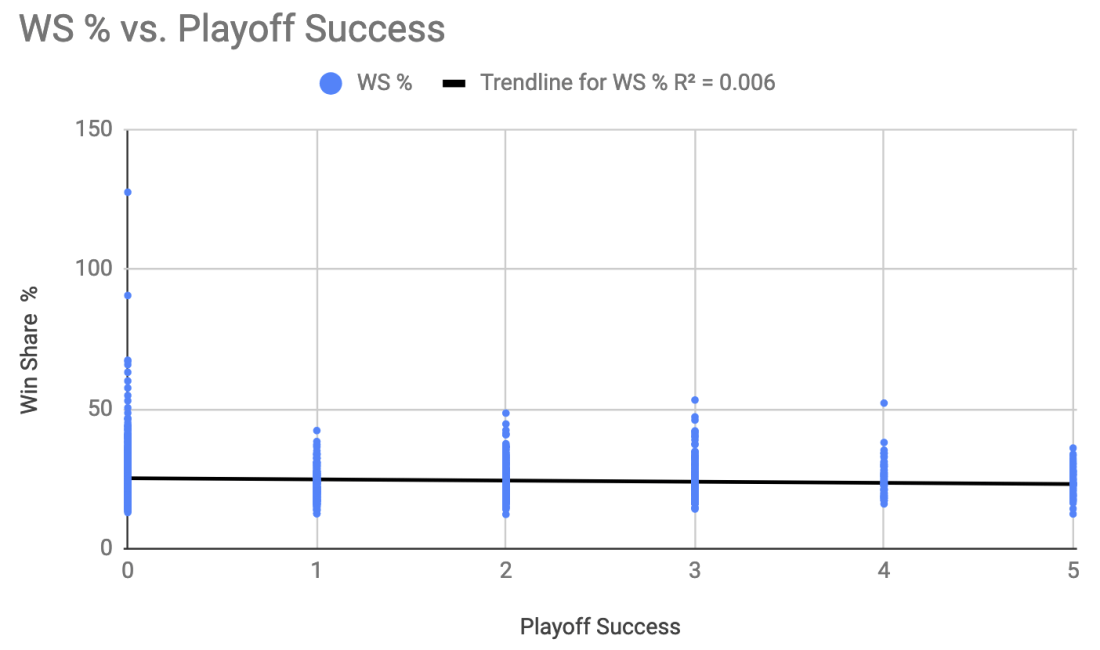
The correlation is every-so-slightly negative, and the thing that stands out is the high values of win share percentages for several teams that missed the playoffs. The outliers from the set of teams that didn’t make the playoffs could be skewing the overall trend-line. Also, of every correlation in this series, this has by far the weakest. For this reason, the analysis is also done once ignoring teams that miss the playoffs.
2.3.2 Win Share Percentage vs Playoff Success for Playoff Teams Only
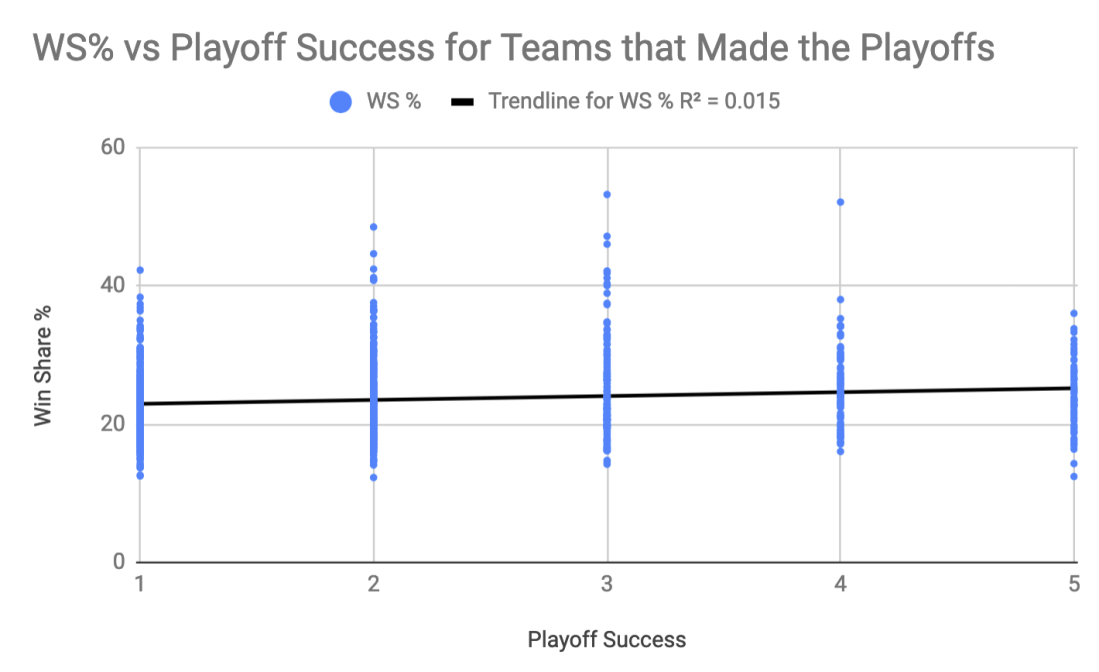
Here there is clearly a positive correlation. While weak, it’s stronger than when the non-playoff teams were included. Interesting to note is that the highest values never actually won the values, once again suggesting that there is a limit to how lopsided a championship team can be. Still, it seems that to an extent, having a player that can carry the team is helpful if you can make the playoffs.
3. Conclusion
It was clear that more wins are correlated with more success, and that more win shares from the top player are also correlated with more success, both in the regular season and in the playoffs. However, when looking at the win shares from the top player as a percentage of a team’s total win shares, the relationships weren’t as strong. The data suggests that being more balanced is beneficial for regular season and playoff success. However, when isolating just teams that made the playoffs and seeing how well they did, having a player with a higher win share percentage correlated with a more successful playoff showing. A potential issue is that there are several outliers for very high win share percentages, and each occurs for unsuccessful teams.
One thing worth exploring in the future is to see if these relationships have changed over time, or basing analysis off of more than one player.
In conclusion, a successful team should have players that can help to shoulder the load, but having a player that can carry the team when the stakes are highest is as important as it’s ever been.

 All-Star Analytics