Make sure to check out part 1 first.
Last time we saw that teams win more games in the regular season when their best player accounts for more total win shares, which should be expected. However, we also saw that while regular season wins were a very strong predictor of whether or not a team would make the playoffs, they weren’t very strongly correlated to success in the playoffs.
1.3 Best Player’s Win Shares vs Playoff Success
While we saw the trend between the team’s total and playoff success, the next question is if the trend is the same with the best player’s total win shares and playoff success.

The labels for the x-axis are the same as in part 1. Once again, the best player’s win shares are a strong predictor of whether or not the team makes the playoffs, but they don’t say much about how well the team does in the playoffs. Also, the win shares from the best player are, as expected, a much weaker predictor of playoff success.
2. Best Player’s Win Share Percentage as a Predictor of Success
As we’ve seen, having a top player that can get more wins for the team is directly correlated to team success. However, to determine if balanced teams are more successful, we need to look at the percentage of a team’s wins that come from one player.
It should be noted, that for only one team, the 1953 Warriors, had their best player have more win shares than the entire team. Niel Johnston accounted for 15.3 win shares, while the whole team only had 12 wins, because the rest of the players combined for negative win shares. This is why each graph will have a point with win share percentage above 100%.
2.1 Best Player’s Win Share Percentage vs. Best Player’s Wins
Before exploring how win share percentage correlates with the success, the first question is whether or not there is any correlation between how many win shares a team’s top player has, and what percent of the team’s total wins that is.
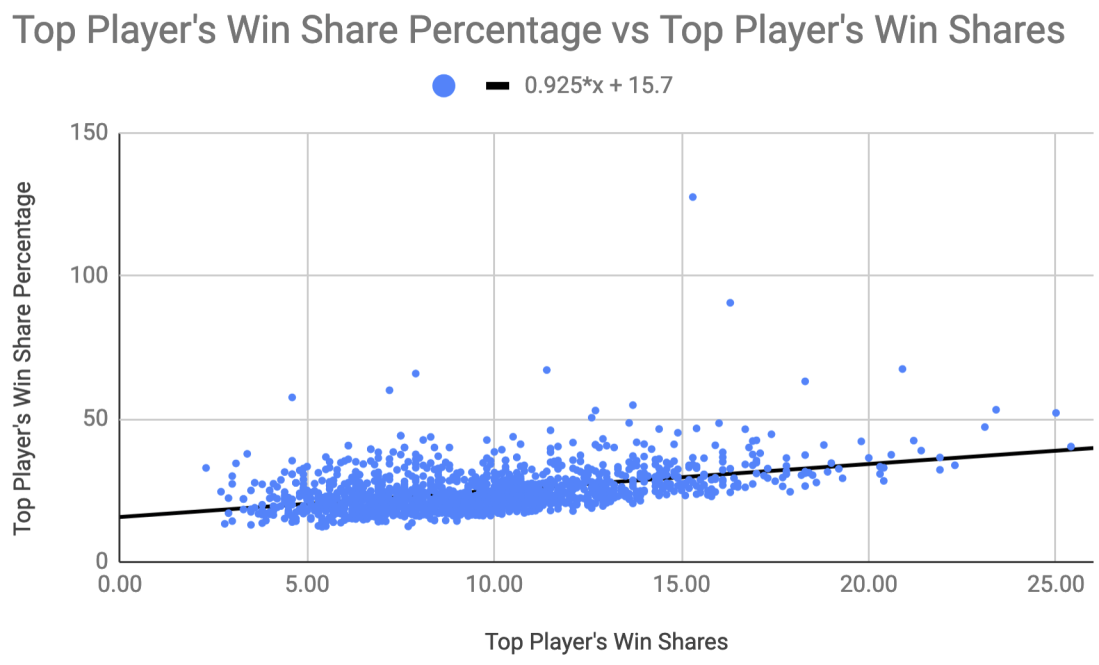
As we can see, when the top player has more win shares, they tend to account for a higher percentage of the team’s total win shares. However, the correlation is pretty weak.
What’s Next
The next part will specifically explore the correlations between win share percentage and regular season success, and win share percentage and playoff success.

 All-Star Analytics